Skills for Rhode Island's Future | Jobs in Rhode Island

SkillsRI offers job search support, career enhancement services, and free training program opportunities to unemployed and underemployed Rhode Island residents.

  • Email
  • Facebook
  • Instagram
  • LinkedIn
  • Twitter
  • YouTube
  • Home
  • Job Board
    • Find a Job
    • Submit Your Resume
  • Training Programs
  • EMPLOYERS
    • Service Offerings
    • WorkABILITY Initiative
  • Prepare RI
  • RI Small Business HUB
  • News & Events
    • Hiring News
  • About
    • About SkillsRI
    • Contact Us
    • Board of Directors
    • Donate

Rhode Island Marine Trades Association Training Program

February 26, 2019

Do you have a passion for Marine Trades?

Attend a FREE 3-week hands-on training that prepares participants for entry-level positions in the marine and composites industries throughout Rhode Island.

Candidates who complete the program can be hired into full-time, year round positions at marinas, shipyards, boat building and repair companies.

Participants will receive a stipend of $100 per week and train aboard a tall ship.

Recruiters are scheduling interviews NOW!

Thursday, February 28, 2019 at 10 AM – 12 PM
NetWORKri | 4808 Tower Hill Rd, Wakefield, RI 02879

Friday, March 1, 2019 at 10 AM – 12 PM
NetWORKri | 1330 Main St, West Warwick, RI 02893

Monday, March 4, 2019 at 10 AM – 12 PM
NetWORKri | One Reservoir Ave., Providence, RI 02907

**Contact Duncan at 401.680.5974 or dermer@skillsforri.com to register.**

Filed Under: Featured, News

Apply to the PrepareRI Summer Internship Program

December 4, 2018

The application for our 2019 PrepareRI Summer Internship Program is now OPEN! All public high school juniors are encouraged to apply for one of 300 available internship spots summer 2019! Get ready to EARN, LEARN & CONNECT! https://bit.ly/2ragAB8

Filed Under: News

Westerly Education Center broadens its capabilities with dedication of new science labs

December 3, 2018

WESTERLY — Greg Viveiros wasn’t sure what to do when Toys R Us went out of business in June, putting an end to his three years as an assistant store manager.

The Warwick resident talked with his wife and the couple agreed that he would take the summer to research his options. “I knew I wanted a career, not just a job,” he said in an interview on Thursday.

In time he learned about a process technology class that was due to start in the fall at the Westerly Education Center. He applied, was accepted, and on Friday completed week six of the 10-week program. Process technology refers to functions and skills common in a variety of industries. The 300-hour program covers chemical processing, sampling and measuring; fluid mechanics; computer control and monitoring systems; basic electricity, pump and valve operations and the basics of material engineering.

On Friday an audience of more than 100 gathered at the Friendship Street facility to celebrate the addition of chemistry and biology labs at the center. The labs are used by the process technology students and instructors. The biology lab will allow the center to expand its course offerings to include the Community College of Rhode Island’s Oceanography, Biology in the Modern World and general geology classes that are set to start in January.

Completion of the labs represents a significant milestone for the education center, which has become a national model, said Brenda Dann-Messier, state commissioner for postsecondary education. The center has created “a pipeline of trained Rhode Islanders to meet the workforce needs of employers and provide well-paying full-time jobs for our residents … and better jobs leads to a better economy,” Messier said.

Under the leadership of Thomas M. Sabbagh, dean of business, science, technology and math, CCRI developed the curriculum for the process technology program. Sabbagh is also credited with playing a significant role in the education center success in winning a Real Jobs Partnership grant for the program, which is offered for free to students.

Although the program is a non-credit offering, Sabbagh said the curriculum was subject to the same type of review and input from the college’s faculty and administration that for-credit courses receive.

“This is only the beginning. Having state of the art labs means we can expand into lots of areas,” Sabbagh said.

Charles “Chuck” Royce, the mutual fund founder and community benefactor whose vision and financial generosity gave rise to creation of the education center, said he became convinced of the value of community colleges while serving on the board of Norwalk Community College in Connecticut. “We’d go through the halls and look into the classes and I realized these folks are here because they want to be, not because they have to be…it was life changing for me,” Royce said.

CCRI and the state’s two other higher education institutions have a presence in the education center, which is also used by private colleges and universities, businesses, and the state Department of Labor and Training. Royce credited his lawyer, Thomas J. Liguori Jr., with helping to develop “the idea for flexible space that could be used for many institutions.”

At the age of 40, Viveiros is just about in the middle of the pack. Students in the process technology program range in age from 19 to 68. Viveiros acknowledged having a level of apprehension toward the beginning of the class.

“I was a little worried about going back to school after not going to college and being out of school for about 25 years, but once I got that first week done I kind of eased back into it,” Viveiros said.

The 16 students in the class were recruited by Skills for Rhode Island’s Future, a Providence-based statewide career readiness intermediary. The non-profit organization works with businesses and unemployed or underemployed residents in association with Gov. Gina Raimondo’s Workforce Board. The agency is currently recruiting individuals for the second cohort of the program.

The education center offers one-on-one remedial math assistance for students who need it, as well as counseling for students who might be anxious about returning to a classroom after a long absence from formal education. The counselors also help potential students find day care and transportation.

The math assistance and the counseling are provided by the Tricounty Community Action Agency. In short, the center tries to help with “anything that might be a barrier to being in a classroom for 10 weeks, five days a week,” said Beth Bailey, a spokeswoman for the education center.

Viveiros said he was initially interested in food processing but more recently has started to think about working at a brewery when he completes the course. But he is keeping his options open. “We’re continuing to take field trips and meet with the different businesses,” he said.

Amgen, Roger Williams Medical Center, Toray Plastics, Rhodes Pharmaceutical, Grey Sail Brewing, Kenyon Industries, Eurofins Lancaster Biopharma, Eurofins Spectrum Analytical, Tedor Pharma and Bradford Soapworks have all committed to hiring students who successfully complete the course. The companies helped formulate the curriculum. Students are visiting the businesses, and representatives of the companies come to the education center to meet with students.

As of Thursday, Viveiros and his fellow classmates had constructed mock tests to detect diseases using chromatography, a lab technique for the separation of mixtures; used a process control computer simulator; and learned how to use a  spectrometer, a scientific instrument used to separate and measure spectral components.

The education center and the process technology course were both good choices, Viveiros said: “My wife says she hasn’t seen me this happy in years.”

Like Viveiros, Jennifer Brown said she wanted a career, not just a job, after her position reviewing mortgages at “a larger bank” was outsourced to another country in June. She had previously left the state’s once thriving jewelry industry, thinking banking was more stable, she said.

Brown, who lives in Warwick, learned of the process technology program through a listing on the state Department of Labor and Training website. She was intrigued, she said, by process technology’s application to a span of industries.

“I thought, wow, this one program could reach into all of these different directions? It’s not so finite that I’d be limited to going into the jewelry industry and designing again. I could go anywhere with this,” Brown said.

Private donors helped fund the construction of the labs and initial purchase of supplies. Grants were offered by Amgen, the Pfizer Foundation, the Westerly Lions Club, the Ocean Community Chamber Foundation, Royce Family Fund, The Washington Trust Foundation, Dime Bank Foundation, Scient Federal Credit Union, the Chelsea Groton Foundation and the Rhode Island Foundation.

The cost to build the two labs was $431,768, and the equipment cost $308,794. About 44 percent, or $327,100, came in grants and donations.

Amy Grzybowski, executive director of the education center, said that opening the labs was an important step.

“The teaching of science is critically important to America’s prosperity and the ability of our businesses to compete globally,” she said. “Providing courses in the sciences elevates the science, technology, engineering and math skills of our local workforce, and teaching labs are an absolute necessity for effective instruction. Because of the generosity of many, students at Westerly Education Center have modern, fully equipped chemistry and biology labs to learn and practice and prepare for their careers.”

Brown thanked the donors and the education center’s other supporters.

“To walk in here and see a facility so well stocked and to have the educational opportunity … this really is changing my future … I actually leave here at night and think to myself, how is this possible?” Brown said.

https://bit.ly/2QeK5kA

Filed Under: News

Event connects the classroom with real industry experience

November 13, 2018

How do you get the message across that there are great employment opportunities in millwork, cabinets, furniture, and woodworking?

The best way is to show the workplace and its use of new technology. And to meet people who have had successful careers at companies that offer opportunities and advancement.

A recent event organized by industry, associations, and education achieved that and more.

The idea for the event was developed by Chris Hofmann, Woodworking Machinery Industry Association’s Education Committee chairman and U.S. Lamello product manager for Colonial Saw. WMIA organized the event with the help of Skills for Rhode Island’s Future, and Herrick & White, a Cumberland, Rhode Island, a manufacturer of architectural millwork, which hosted the meeting and provided tours as well.

Initially, Hofmann wanted to develop a live trade show-type event.

“When I was appointed chair of the WMIA Education Committee, I had a vision for developing something like a condensed trade show environment that would involve vocational high school students, educators, hopefully parents, industry vendors, and all the while also be centered around an engaging tour of a contemporary, dynamic shop,” he said.

“We found a great partner in Herrick & White to launch this concept for our inaugural event and I couldn’t be more pleased with the outcome. Feedback from the students and educators was terrific. By introducing the students to the shop environment, industry vendors, and post-secondary woodworking schools, we gave them a great cross-section of many available opportunities all in the span of about two hours per school.

Hofmann said there were five schools that participated, including 80 students. WMIA is in the planning stages for a similar event in Massachusetts for the spring of 2019. Once that second event is complete, he said they are going to work to create nationwide events multiple times per year.

Another participant, Skills for Rhode Island’s Future, is an organization that provides high school students with paid summer work-based internships. The program connects education with the workplace, allowing students to learn about a job they may want to pursue.


Students see the design, planning and fabrication process in Herrick & White’s operation.


Changing perceptions

Ken Bertram, president of Herrick & White, said that he and Hofmann had earlier discussed the need to change the perception of the woodworking industry, which led to the open house concept at his architectural millwork company.

“We have been working with schools over the past several years, bringing in student interns for the purpose of bringing youth into the industry,” he said. “This was a great opportunity to capture many students at one event.”

Bertram said that people have the perception of the woodworking industry as a couple of guys in a garage covered in dust and missing some digits. This perception makes it more challenging to find employees.

Also, there is little emphasis on the trades in school.

“Primarily kids are guided towards college,” Bertram said. “The schools have had their vocational programs decimated by budget cuts so the kids that actually want to pursue a vocation don’t get the level of experience necessary or the building (of) enthusiasm for the trade. One of the goals of this event is to start to change the perception and make woodwork manufacturing an enticing opportunity for the future workforce.”

Bertram said that Herrick and White wanted to demonstrate that woodwork manufacturing reaches far beyond assembling a cabinet at a bench, and that there are career opportunities available, such as supervision, engineering, estimating, project management, accounting, sales and marketing.

“We wanted them to understand that if they came in with drive and a great attitude they can enter a trade right out of school and then develop their career in a direction they choose,” he said.


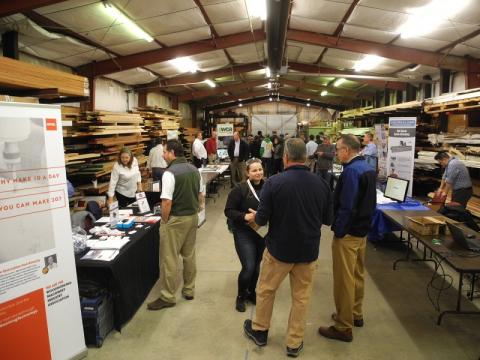
Vendor displays were open for visiting students to ask questions and interact with suppliers.


Partnering with industry

Larry Hoffer, WMIA president and CEO, said that the asscoaition’s member companies are also involved in this effort.

“Many WMIA-member companies pursue different avenues to solve the skills shortage, such as partnering with local VAs to find employees and developing internships with schools in their area,” Hoffer said. “On the whole, WMIA is part of WIRC, the Wood Industry Resource Collaborative, a multi-association collaboration that is working to bridge the skills gap by changing the perception of the industry among the next generation, their parents, and school counselors.

“(At this event) the students had the chance to better understand the diversity of the woodworking industry, the different machines and software used and the philosophies behind them, and they had the opportunity to talk with professionals currently working in the industry, to see what career paths might be available to them and how they might pursue them.”

WMIA is working on another open house in early 2019. “It is our goal to hold at least four of these events next year, and eventually create a prototype that our members can utilize in their own communities by partnering with vendors and schools in their area,” Hoffer said.

Students see an architectural millwork shop in action.


View from education

One of the schools participating in the event was the Woonsocket Area Career and Tech Center. Charlie Myers teaches Architectural Construction Technology, and has been an instructor there for 21 years.

“We do not have any woodworking programs anywhere with the Woonsocket Education system at any age or level,” he said. “We will work on a woodworking project on an individual basis if a student would like to build a bookcase or shelf but the program was not recruiting enough students to keep it active.

“The wood shop classes in the middle schools have also been eliminated when the teachers retired. The wood shop class in the high school has also been chopped. There is no longer any exposure to any trades until a student goes on a tour in the ninth grade. It is difficult to demonstrate all of the possible career paths in construction in a seven-minute time limit.”

Myers said he really enjoyed this event, and six students filled out an application to work there.

“This is a career that they had not considered before the tour,” he said. “I believe they finally saw a combination of skills and artistry in the projects being made there. They were also excited that two former graduates had worked their way from the entry level to an ownership level.

“I believe they saw a career where they can advance within a company and support themselves as adults. I think this is what they are looking for. A means to support themselves and their families as their skills improve….so will their income. I do not believe they have seen any examples of this in their employment so far and they were excited!”


Herrick & White’s Ken Bertram, from left, Gary Rousseau, and Steve Brannigan greet visitors.

Shop tour

Herrick & White president Ken Bertram showed a video to each group and described the history of the company, which started in 1977 and makes high-end specialized architectural millwork.

The company has many highly skilled and experienced longtime employees, but Bertram said that 10 percent of the current workforce.

“We are committed to growing our own workforce,” he said.

Company representatives emphasized to students that there were great opportunities for growth and promotion within the company, and offered their own experiences of holding many different positions as examples.

Gary Rousseau, executive vice president of sales and marketing, outlined his experience from Woonsocket Vocational to Herrick & White, dating back to 1979. He ran the shop, purchasing, and sales and marketing. “They gave me confidence,” he said. “And every day is a new adventure.”

Steve Brannigan is executive vice president of finance and chief financial officer, and also has had a long career at the company with many different positions. He said it is about much more than woodworking. “I have done every position in this company,” he said. He believes students today have the same opportunity he did, and Herrick and White is dedicated to growing their own talent.

In the shop, students saw the engineering department and saw how project management was handled from planning to installation.

They looked at the process beginning with rough lumber, cutting and machining, and assembly and fabrication.

In the shop were a Holzma panel saw, Anderson Exxact CNC router, Brandt edgebander and SawStop table saws. Of special interest to students was a Weeke Optimat BHP 008 CNC machining center, demonstrating the technology used in wood products manufacturing today.


Vendor contact

A group of industry organizations and companies was also present at the event, and visiting students could meet and ask questions of any of the representatives.

In addition to WMIA, the Woodwork Career Alliance was present, along with Colonial Saw, Stiles Machinery, KCD Software, Weinig-Holz-Her, SawStop, Cabinet Vision and Atlantic Machinery.

Herrick & White actually received one application from a student the day of the event, and several more students said they would apply and many took applications with them.

“I expect we’ll pick up a couple of student interns in the short term,” said Ken Bertram. “I expect our summer intern program will have several more applications, and more students will pursue woodworking as a career choice then before the event.”

“This mission to expose the youth to the modern day woodwork manufacturing environment is imperative for the future of the industry.  Great job from Skills for Rhode Island’s Future and WMIA for pulling it all together!”


https://bit.ly/2Dw3GWz

Filed Under: News

My Turn: Jennie Sparandara: Businesses should lead in R.I. education

July 2, 2018


By Jennie Sparandara

Posted Jun 29, 2018 at 5:50 PM

Earlier this year, more than 100 educators and business leaders from Rhode Island and across the country met in Providence to talk about preparing students to succeed after high school and in their career.

During this national convening on career readiness, Ty’Rell Stephens, an 11th grader at Juanita Sanchez High School in Providence, talked about the opportunities he has access to in high school, and how they have increased significantly since his freshman year. Ty’Rell is participating in the community development career pathway at his school and will earn several college credits before he graduates.

Through the PrepareRI initiative, Ty’Rell’s experience is being replicated at schools across Rhode Island, with more students than ever are earning college credits, tackling advanced coursework, and gaining hands-on work experience that will set them on a path to postsecondary success.

Hearing about gatherings like the one in Providence reaffirms for me the importance of involving industry leaders in the design of education. My company, JPMorgan Chase, is working in Rhode Island and nine other states through a $75 million initiative called New Skills for Youth. We developed New Skills for Youth in collaboration with the Council of Chief State School Officers, Advance CTE, and Education Strategy Group. The effort includes a $35 million investment in states to strengthen career readiness approaches, giving students multiple pathways to training and education beyond high school.

Career pathways — which include anything from health sciences to business administration to agriculture — allow students to build real-world skills, explore career opportunities and find a career path that they are passionate about before they begin college.

One of the pathways educators and business leaders have teamed up on is the newly created process technician pathway, which will prepare students to enter an Environmental and Life Sciences program at the post-secondary level and to be job ready as a process technician, a job that earns an average of $24 per hour in Rhode Island. The pathway was created in partnership with higher education officials and leaders from several of the state’s largest biomedical and pharmaceutical employers in response to their industry’s needs. It combines academic requirements such as life sciences, chemistry and math, with safety training, industry credentials, and internships.

At the Providence convening, participants were able to see these kinds of innovative efforts in action on a tour to the Davies Career and Technical High School, which houses the nation’s first in-school mock CVS pharmacy. Davies designed this in partnership with CVS to give students hands-on training by the time they graduate from high school. Many of these students have summer jobs with CVS and plan to continue their pharmacy studies after high school.

Additionally, this summer, the PrepareRI Internship Program will kick off its pilot year by training and placing at least 100 students in paid internships with the state’s top employers in a range of industries. With funding from the Governor’s Workforce Board, and support from our New Skills for Youth initiative, the team in Rhode Island brought in an intermediary, Skills for Rhode Island’s Future, to facilitate the internship program and to help forge stronger connections between education and industry.

Career pathways and internship programs like the ones here in Rhode Island have real-world positive impacts on students. Research and anecdotal evidence show us that investing in career readiness is good for students. In fact, 75 percent of students who complete a career pathway go on to enroll in college. But this work is good for businesses, too; it’s a win-win. Industry leaders know that the jobs they need to fill require skilled workers.

Why not take an active role in training that next generation of employees?

If you’re a business leader in Rhode Island, I challenge you to think about how you can support students like Ty’Rell and the great work already happening in your state’s schools. Whether your investment is with money, advice or time, I urge you to learn more about PrepareRI and contact the team at Skills for Rhode Island’s Future to figure out your first step.

Jennie Sparandara is the executive director of global philanthropy for JPMorgan Chase.


Click here to read the full article

Filed Under: News

  • « Previous Page
  • 1
  • …
  • 5
  • 6
  • 7
  • 8
  • 9
  • 10
  • Next Page »

<a class=”button” href=”https://skillsforri.com/job-seekers/apply-now/”>Apply Now</a>

Main Menu:

  • Home
  • Job Board
  • Training Programs
  • Employers
  • About SkillsRI
  • Contact Us

More Information


Contact Information

30 Exchange Terrace
Providence, RI 02903
401-680-5960

Privacy

For information on how we collect and manage your data please see our Privacy Policy & Disclaimer

© 2016 Skills for Rhode Island’s Future